

09 Aug Homegrown vs Microwave – Embracing Food, Cutting Shame, and Striving for Health
Did you know that eating food is good for you? I know, it’s shocking!
But when it comes to WHAT we eat, HOW we eat, how MUCH we eat, and how OFTEN we eat, there’s eight billion different opinions on what healthy eating actually is.
As someone with a bachelors in food and nutrition, I get that among other variables, every person is navigating their own nutritional needs, budget, cultural norms, food availability, cooking skill, positive or negative associations with certain kinds of food, and personal preference for taste or texture. Eating is not (and cannot be) one-size-fits-all.
So let me start by sharing my personal opinion on what healthy eating looks like, in this order:
- Eating food is better than not eating food.
- A diet with whole foods and variety is better than a diet without whole foods or variety.
At one point, I spent 3 years on a restricted diet of ONLY fruits, vegetables, and meats, shunning all processed foods, sugar, grains, dairy, eggs, legumes, and nightshades. It seemed like a good idea at the time, but you know what? Even with all the amazing fresh fruits and vegetables, I was still undernourished, and it created patterns of fearful eating behaviors I had to overcome later. I’ve also spent years navigating medical issues that kept me from choking down much more than goldfish crackers and cheeseburgers, and that wasn’t ideal either. I survived both, learned from both, and find myeslf aiming for somewhere in between.
With that said, let’s talk about how this applies in the very specific context of a person living with chronic illness who is doing their best while navigating real-life limitations. Personally, I abide by three main principles when it comes to eating. First, just because something is easy to make or eat, doesn’t make it bad or shameful. Second, home-cooked food is awesome, but only when doing so doesn’t cause profound ramifications. And third, there’s always a solution to eating well, even if things feel overwhelming.
-
Easy Doesn’t Mean Bad
Microwave meals have had cultural highs and lows. Touted for the ease and convenience, they also carry the weight of a growing understanding of chemical leaching, microplastics, generating lots of waste, and higher levels of sodium/sugar/preservatives. But I’m going to be so honest with you right now: I praise God for the existence of microwave meals, because they enable me to live and thrive in so many areas of my life.
Did I mention my full degree title is literally “sustainable food and nutrition”? I know. My young college self who dreamt of a fully self-sustaining garden and homestead would have some strong feelings about where I’m at now.
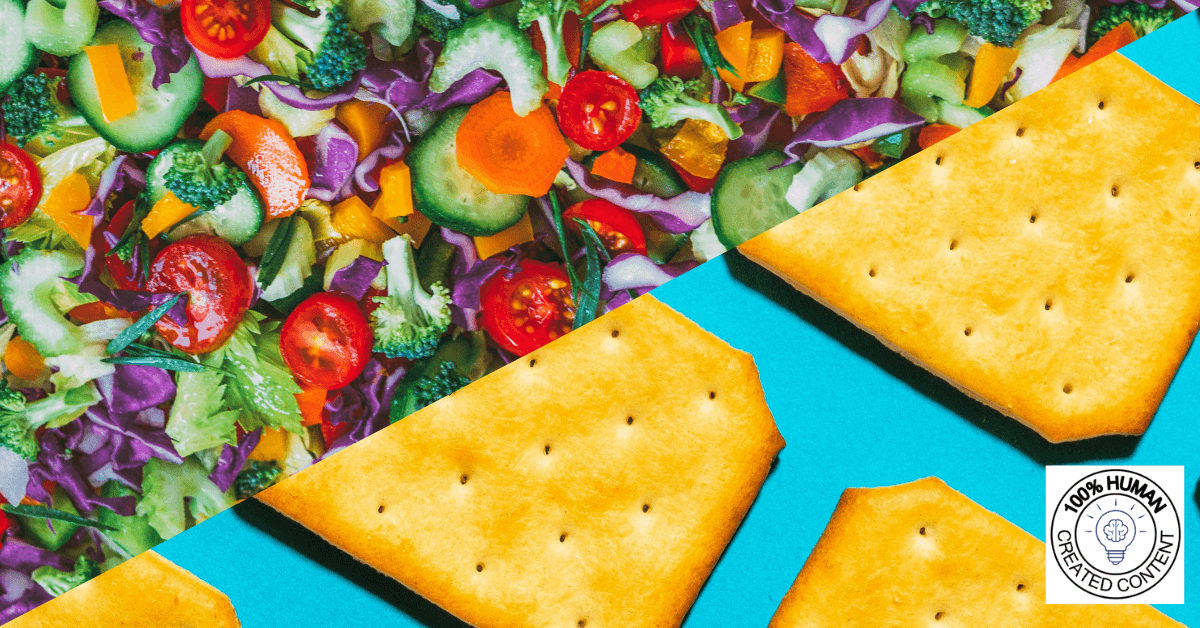
But in this modern era of history, we have the distinct blessing of having food readily available to us that is relatively balanced, nutritious, and affordable. We can buy grilled chicken strips, frozen and ready to give our bodies protein. There are veggies that come prewashed, chopped, and seasoned, ready to be roasted and give our bodies fiber and micronutrients. There are brown rice pouches, ready in minutes and giving our bodies complex carbs and energy. It is not wrong or shameful to utilize the convenience food items available to us. On that same note, on days when my physical symptoms have me in a figurative chokehold, or my mental health is not health-ing, it’s ok to take it a step further. Chicken nuggets are not sinful. Chips and ice cream are not failure. Fast food is not evil. (Take a deep breath with me if you’re a high achiever with black and white standards and nutrition hangups. It’s going to be ok)
YES. Wisdom matters. YES, getting nutrients and fiber is important. But also, food is calories, and my body cannot get stronger if it is perpetually starved of having enough energy. When I feel like skipping a meal because the fatigue is crushing, I remember my little motto: I don’t get to choose whether or not I eat – I only get to choose WHAT I eat. Each of these convenience food items have calories and varying levels of protein, carbs, and fats to help my body get through this. Fruits, veggies, and unprocessed meats are amazing nourishment – and yet something IS better than nothing when working back towards whole foods and variety.
(Again, this is a personal opinion that helps me in my specific context with where I’m at right now. When it comes to POTS, often eating makes my symptoms worse, and yet being underweight with a minimum sodium requirement means high calorie processed foods help me reach multiple goals. I understand that may not be you, so please take your own context into account, abide by the specific recommendations of your medical providers, and use your own good judgment).
2. Home-cooked is awesome, but only when able.
Food is foundational, but there can be more important things to focus on. I AM able to make homecooked breakfast, lunch, and dinner at this stage of my recovery, but I can guarantee that if I did, I wouldn’t be able to have a job or attend social gatherings with the remaining energy/positional tolerance. In order to have a functional and well-balanced life that includes meeting my physical, emotional, spiritual, and relational needs, I MUST moderate.
On a weekend, I LOVE making chicken parmesan risotto from scratch or baking homemade bread!
On a weeknight, I enjoy taking a few partially-prepped foods and making a meal (like slicing chicken sausage, and roasting it with a bag of chopped and seasoned veggies).
On a flare-day, I have a premade protein drink for breakfast, a microwave lunch, and maybe a microwave dinner, too.
Personally, I consider each of these scenarios a successful day of being faithful to meet me nutritional needs while tending to my overall health. Each of these is a celebration of independence in the midst of a fluctuating disability.
3. Don’t panic – there’s a solution.
To be alive takes effort. When everything feels overwhelming and starts to feel impossible, one crucial principle I abide by, is to trust that there IS a solution.
I love a good whiteboard, notepad, or my notes app. When food is hard to acquire, hard to make, or hard to eat, brainstorm! Here’s some things from my own personal brainstorm sessions that have helped me tremendously:
- Use walmart grocery pickup
- Join a friend while they grocery shop
- Ask a friend to shop
- Apply for SNAP food assistance, see if you qualify
- Make a detailed meal plan so you know exactly what you’re eating this week
- Keep a snack basket on the counter so you can always grab something easy-peasy
- Get snacks to eat for WHILE you make dinner to keep morale and energy up
- Buy rotisserie chickens, shred them, and stash it for throughout the week.
- Make a list of foods you like, so you don’t have to try and remember things to eat or make when the time comes
- Eat the same thing every day, OR buy variety to keep yourself interested – whichever you need
- Purge the old food that you’re not going to eat, especially in the fridge
- Don’t be afraid to eat fast food if it’s between that and skipping a meal.
- Watch cooking videos to get ideas and to renew interest in food
I wrote another article dedicated to other practical things that help me (read it here). Your ideas might look different, and feel free to post them in the comments for others to see!
Longing for a day to come, while embracing the day that is here
Sometimes I ache for the day I used to work in food service, making delicious dishes day after day, only to come home after a long shift to continue excitedly experimenting in my own kitchen. But I also want to take a moment of gratitude, that I am no longer confined to my bed and unable to stand for long enough to put my own leftovers in the microwave.
Right now, I’m learning to find peace in the middle, between the extremes and remembering what I’m learning about accepting my limits as a finite human being.
As such, I invite you to join me on the journey of accepting the present, and doing our best to be faithful with what is available to us in energy, ability, and wisdom. May we learn how to set ourselves up for success in whatever context we find ourselves in, seeking to make the next right choice as it comes to us in the short and long term.
-

Celebrate the Wins and Keep Going – The Faith Journey
This week marked a big milestone for me in my journey of spiritual and emotional recovery. With the blessing of a community at Celebrate Recovery, I proudly received my 18 month “chip” celebrating the recovery from my personal “hurts, habits, and hangups.” It had me thinking about the faith journey, and how it has many stages. ...
11 September, 2026 No comment -
Ultra-Practical Ways To Make Eating Easier
This article includes ways to moderate energy expenditure while preparing food, low energy meals I love, and little “life hacks” I use as a single-person household with chronic illness. I've talked a bit about getting rid of shame and keeping a solution-based mindset when eating is tough (which you can read about here), but here are my *actual* tips that I think are worth consideration if this is a struggle area for you. Please feel welcome to share your own ideas...
28 August, 2026 2 Comments -

Giving and Receiving Strength When Weary
There is a verse that says "Let us not become weary in doing good, for at the proper time we will reap a harvest if we do not give up." Galatians 6:9 Recently I was struggling, and in my futile efforts to control my life, I found myself weary. While I was tempted to look around jealously at those who seemed to have it easier, I paused, and asked God to come be my strength....
23 August, 2026 No comment

Pingback:Ultra-Practical Ways To Make Eating Easier - Kaley Faith
Posted at 15:54h, 28 August[…] rid of shame and keeping a solution-based mindset when eating is tough (which you can read about here), but here are my *actual* tips that I think are worth consideration if this is a struggle area for […]